Two angle types released in Castle Peak avalanche report—Here’s what they mean
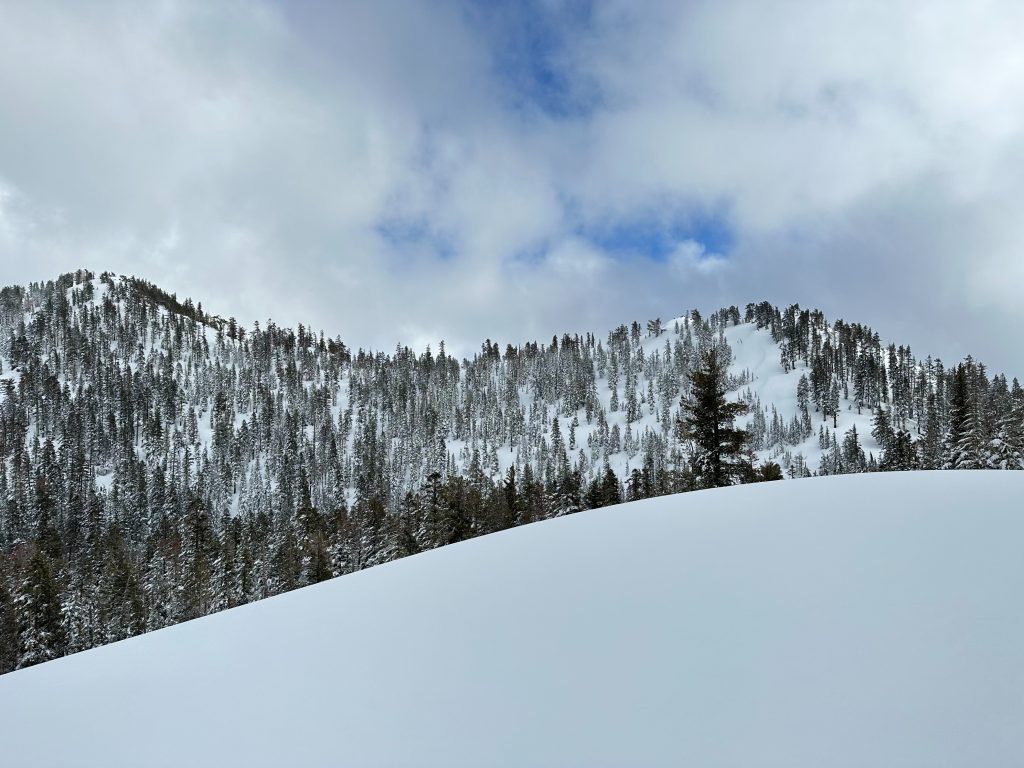
Provided / Sierra Avalanche Center
TRUCKEE, Calif. – Investigations are ongoing into the deadly Feb. 17 avalanche near Perry Peak. The Sierra Avalanche Center (SAC) continues to release new details as their investigation unfolds.
Recently released details include angles related to the avalanche, particularly the slope angle and alpha angle.
Here’s what these angles mean.
Slope angle
The slope angle is a value of steepness and key factor in determining the likelihood an avalanche will occur on a slope.
Around 76% of avalanches take place on slopes between 34 and 45 degrees.
Slopes greater than 50 degrees are typically so steep that small avalanches occur frequently, making larger avalanches rare.
Slopes less than 30 degrees typically aren’t steep enough for an avalanche to occur. However, if connected to steeper slopes, it is possible larger avalanches could run onto such low angle terrain. How far out onto low angle terrain an avalanche can run varies. That’s what the alpha angle measures.
Alpha angle
The alpha angle is a measure of how far avalanches run from their start zone to the bottom of their debris piles.
Small avalanches may start in steep zones but not travel very far down a slope. As avalanches get bigger, they may travel further down a slope and as mentioned above, even onto lower angle terrain.
The greater the avalanche and further out it runs, the smaller the alpha angle number.
Alpha angles for extremely large “100 year” avalanches are typically in the 18-20 degree range, depending on specific mountain ranges and other factors. Some sources put them between 18 to 22 degrees.
Alpha angles also give backcountry users an idea of how far to stay away from steeper slopes when traveling near them in certain conditions.
Staying less than 18 degrees from a potential avalanche starting zone reduces the likelihood of getting caught in a large slide. The American Avalanche Institute recommends at times of extreme instability, to be as far away as 15 degrees, particularly when choosing a campsite.
Angles of the Castle Peak avalanche
SAC says the slope angle in the area where the avalanche likely started ranged from about 36-40 degrees.
Given it is within the angles in which most avalanches occur, SAC executive director, David Reichel says, “This is expected but also one of the things that we confirm in accident reports.”
Their report reveals that the victims in the avalanche were buried near the toe of avalanche debris.
SAC calculated the alpha angle from the burial location to the estimated starting zone as 22 degrees when measured on the ground and 25 degrees when calculated on a map.
According to maps with the burial site marked, the location appears to be within low angle terrain.
Where the ski group was just prior to the avalanche is currently unknown or has not been released.
The group consisted of 15 members on a guided multi-day backcountry hut trip. The avalanche occurred on the group’s return journey.
Questions continue to circulate regarding the decision to return despite an active heavy winter storm and high avalanche danger.
Both the Nevada County Sheriff’s Office and Cal/OSHA continue to investigate the incident.

Support Local Journalism

Support Local Journalism
Readers around Lake Tahoe, Truckee, and beyond make the Sierra Sun's work possible. Your financial contribution supports our efforts to deliver quality, locally relevant journalism.
Now more than ever, your support is critical to help us keep our community informed about the evolving coronavirus pandemic and the impact it is having locally. Every contribution, however large or small, will make a difference.
Your donation will help us continue to cover COVID-19 and our other vital local news.