Where do unused snowplow funds go after light winters?
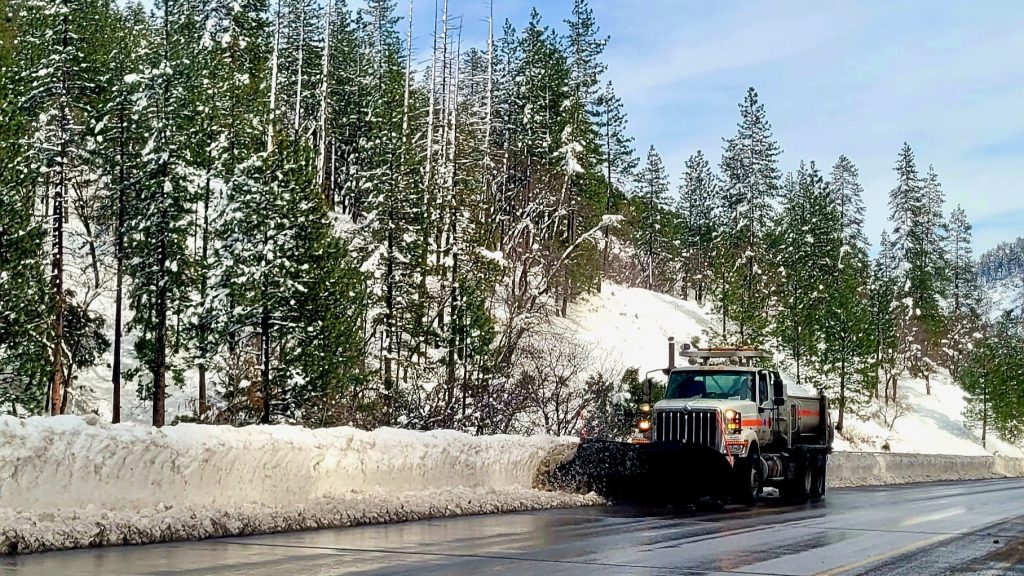
Maya Duhl / Tahoe Daily Tribune
LAKE TAHOE, Nev./Calif. – Even with the recent storm, this winter did not measure up to the winter many hoped for. But what the region lacked in snow, will it save in revenue due to fewer days of plowing?
Less snow doesn’t necessarily mean savings. That is partially due to the fact that snow removal supplies are typically purchased in advance.
“These items cannot be purchased reactively during a storm,” El Dorado County Department of Transportation Fleet Superintendent Nathan Haynes said, “so they are stocked ahead of time to avoid service delays and safety risks.”
Additionally, operations often rely on salaried personnel (who perform other road duties when it is not actively snowing).
Most jurisdictions and agencies, like regional counties, the Nevada Department of Transportation, and Caltrans in the Truckee-Tahoe region, do not have separate funds for snowplowing. Instead, funds for these winter operations come out of a general road maintenance fund.
That means any savings would go towards other maintenance operations such as filling potholes, street sweeping, sealing pavement cracks, and striping, among many others. In contrast to a low-snow year, heavy-snow years often require pulling funding from other areas to cover additional costs.
“Any savings from a low-snow winter in Tahoe are a welcome relief…” Washoe County Communications Manager Bethant Drysdale said. “Those savings remain available to support the backlog of maintenance.”
In California, counties are given an apportionment each year from the state controller, called reimbursable snow removal costs. These funds are often quickly expended and don’t cover the entirety of snow management operations.
For example, in Placer County, for the 2025-2026 fiscal year, the county received $1,075,619, but even in this low-snow year, it has already spent about $1.7 million on snow operations before the latest storm.
The City of South Lake Tahoe is one agency that does have a specific snow removal fund. Rather than reallocating the savings elsewhere, Director of Finance Olga Tikhomirova said any unspent money will carry forward to the next fiscal year and will help reduce the amount of General Fund support needed for snow removal in the upcoming budget cycle.
These snow removal costs are just one way snow impacts regional budgets. Beyond these direct costs, winters have a broader and more significant impact on revenues.
“In the Tahoe Basin, we spend a disproportionate share of our road funding because of the severity of winter conditions,” Placer County Deputy Director of Public Works Matt Randall said. “Snow removal is only part of the cost—the long-term damage to roads and equipment continues well after storms end.”
A recent pavement study across Placer County found that pavement conditions worsen above 3,500 feet due to freeze-thaw cycles that accelerate pavement deterioration. The study also shows that if maintenance is deferred, repair costs increase considerably.
Revenue for roads often comes from fuel taxes. Another challenge is maintaining these revenues as cars become more efficient and drivers increasingly choose electric vehicles, making excess road funds even more unlikely.
“So the bottom line is this: there is no “extra” or unused snowplowing money,” Randall said. “Even in lighter winters, the available funding is fully absorbed by current operational needs, ongoing pavement and equipment impacts, and a transportation revenue structure that is expected to become more constrained over time.”
 Loading ...





Support Local Journalism

Support Local Journalism
Readers around Lake Tahoe, Truckee, and beyond make the Sierra Sun's work possible. Your financial contribution supports our efforts to deliver quality, locally relevant journalism.
Now more than ever, your support is critical to help us keep our community informed about the evolving coronavirus pandemic and the impact it is having locally. Every contribution, however large or small, will make a difference.
Your donation will help us continue to cover COVID-19 and our other vital local news.