Written in stone: The geology of Truckee–Tahoe

Vast, polished granite walls rise from forests and lake shores, shaped by forces far older than the rock climbers who now trace routes across them. Standing beneath formations like Snowshed Wall at Donner Summit, where climbers begin inching their way up the stone as soon as the snow melts, it’s hard not to wonder: how did this landscape come to look like this?
If Truckee-Tahoe’s rocks could speak, they would tell a story stretching back millions of years.
According to the Lake Tahoe Basin Management Unit, around five million years ago, movement along major fault lines caused large blocks of the Earth’s crust to rise and fall, helping form the Sierra Nevada crest. In the area where Lake Tahoe sits today, two blocks lifted on the east and west while the land between them dropped, creating a deep valley.
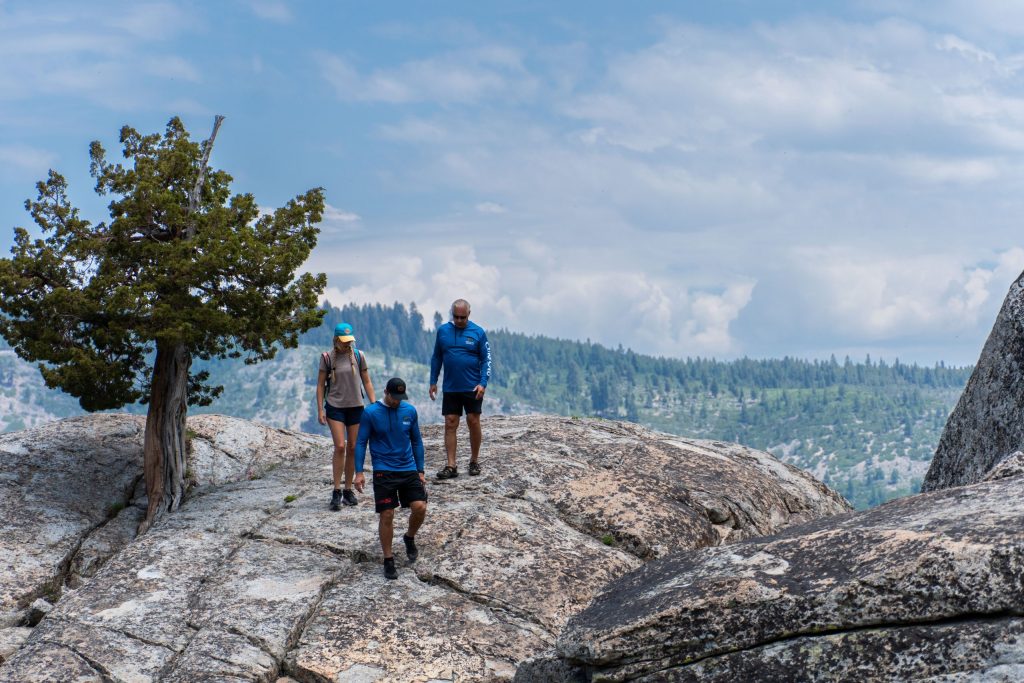
At the time, the area was not yet a lake. Snowmelt flowed north through the valley, draining toward the Great Basin. About two million years ago, several large volcanic eruptions occurred. One of these — from Mount Pluto — sealed the basin’s northern outlet with lava and mudflows, allowing rain and snowmelt to gradually fill the valley and form Lake Tahoe, explains LTBMU.
Glaciers later reshaped the landscape. During repeated ice ages, thick ice covered much of the region, grinding across the terrain and stripping away layers of weathered rock and soil. The glaciers also carried a large amount of rock material, dumping polished granite into different areas of the Lake.
When the glaciers retreated, they left behind the polished stone, jagged peaks and scattered lakes that define the Truckee-Tahoe region today.
However, geologists continue to debate portions of the basin’s history and timeline, with some arguing that the existing Lake Tahoe Basin interpretations are outdated.
For example, author and civil and environmental engineer David Antonucci argues in his book, Geology of the Lake Tahoe Basin, that volcanic activity along the North Shore occurred earlier, between 4 million and 6 million years ago. He contends the tectonic faulting that formed the basin began later, roughly 3.5 million years ago, and continues today, arguing that the region’s geologic history is more complex than the official interpretation presented by the Lake Tahoe Basin Management Unit suggests.
Overall, many of Tahoe’s most recognizable rocks still show evidence of this long geologic story, and social history too.
Eagle Rock is a prominent volcanic landmark on Lake Tahoe’s west shore, formed over two million years ago. Today, the short hike to its summit offers sweeping lake views.
On the southeast shore, Cave Rock holds both geologic and cultural significance. The formation was once part of a volcanic vent that formed about five million years ago. Over time, waves carved caves into the rock when lake levels were hundreds of feet higher during glacial periods.
For the Washoe Tribe, the original inhabitants of the Tahoe Basin, Cave Rock is a sacred site believed to hold powerful spiritual energy. Traditionally, only Washoe shamans were meant to visit the rock, which served as a place for ceremonies. In 2017, the site was designated a Traditional Cultural Property and added to the National Register of Historic Places. Rock climbing is now prohibited there.
Farther north, Donner Pass is known for its dramatic granite and metamorphic formations. Today, the area is a premier destination for rock climbing, with walls like the Black Wall showcasing the rugged stone shaped by the tectonic forces that lifted the Sierra Nevada.
From volcanic vents and glacier-polished granite to boulders slowly cracking in winter frost, Tahoe’s rocks are a record of the region’s deep past.



Support Local Journalism

Support Local Journalism
Readers around Lake Tahoe, Truckee, and beyond make the Sierra Sun's work possible. Your financial contribution supports our efforts to deliver quality, locally relevant journalism.
Now more than ever, your support is critical to help us keep our community informed about the evolving coronavirus pandemic and the impact it is having locally. Every contribution, however large or small, will make a difference.
Your donation will help us continue to cover COVID-19 and our other vital local news.